
Somewhere in North Carolina right now, a teacher is building a school garden without knowing another educator is doing the same thing ten miles away. A funder is trying to decide where investment is most needed, but can only see a fragment of the landscape. A nonprofit leader is writing a grant and wishing they had hard data to back up what they already know to be true: that too many students have never grown a plant at school.
That changes now.
At the 2026 Growing School Gardens Summit in Phoenix, the School Garden Support Organization (SGSO) Network and its partners launched the National School Garden Map. This interactive, publicly accessible tool compiles and visualizes school garden data from across the United States for the first time.
What the National School Garden Map Does
The National School Garden Map layers school garden locations, support organizations, social vulnerability indicators, and climate risk data into a single interactive platform that anyone can explore. Users can spot patterns, pinpoint gaps, and ask harder questions about where resources have and haven’t flowed.
Built on Gen:Thrive technology and infrastructure developed by EcoRise, the map was made possible through a collaboration with the SGSO Network and partners at Edible Schoolyard, Kids Gardening, and the National Farm to School Network, as well as funding from the USDA Patrick Leahy Farm to School Grant and the Sprouts Healthy Communities Foundation. Educators, nonprofit leaders, funders, and policymakers can now use it to identify partners in their regions, build the case for investment, and direct resources toward the communities where gardens are absent and need to grow.
“I’m using Gen:Thrive to figure out which Title I schools to visit around me so I can talk to them about school gardens.”
— Summit participant
“A national view of school gardens and their support networks is a monumental step forward. This will fuel smarter, more sustainable growth, collaboration, and investment across the movement.”
—Tristana Pirkl, SGSO Network
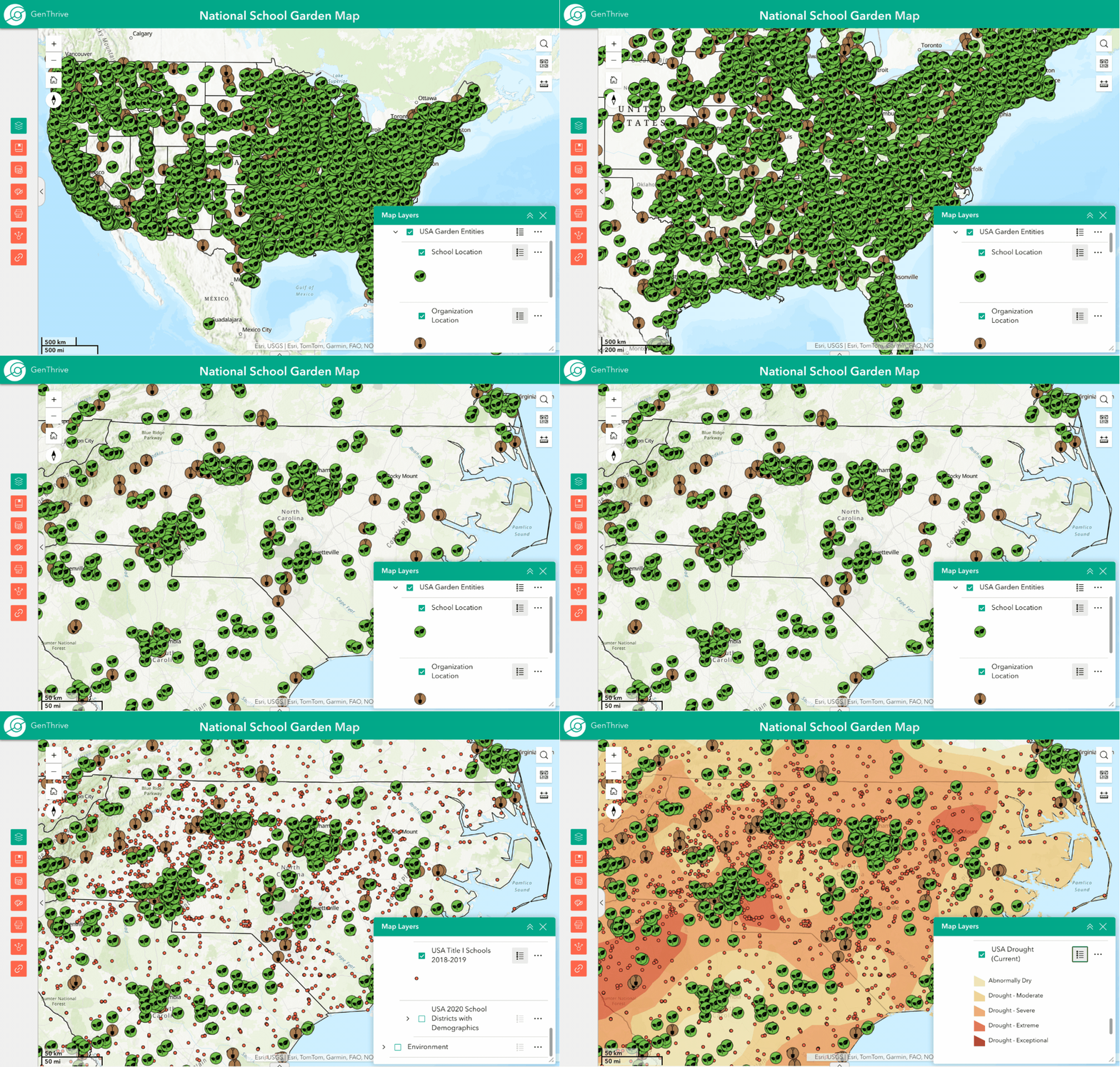
The National School Garden Map, built on Gen:Thrive technology, layers garden locations, social vulnerability indicators, and climate risk data into a single view. In this GIF you can see the National Map zoomed into North Carolina with the Title I school layer turned on, then the Drought Index Layer turned on.
Understanding Where School Gardens Aren’t Reaching Students
One of the most important pieces of data the map reveals is where school gardens are not. Data alone does not create change, but it makes change possible. When funders can see which ZIP codes and school districts lack garden infrastructure, when advocates can point to specific regions where investment has not reached, and when communities can see themselves reflected or absent in a national dataset, the conversation about equity shifts from intuition to evidence.
Summit participants saw this play out in real time during the session “Mapping the Movement: Leveraging School Garden Data to Drive Action,” co-facilitated by Tristana Pirkl and Daniel Barrera Ortega (SGSO Network), and Kristi Hibler-Luton and Daniel Ramirez (EcoRise).
“I live in the San Diego area, and there’s a LOT of icons for school gardens. But I went to North Carolina in the map, and there are a lot of Title I schools without school gardens, which was really interesting.”
— Summit participant
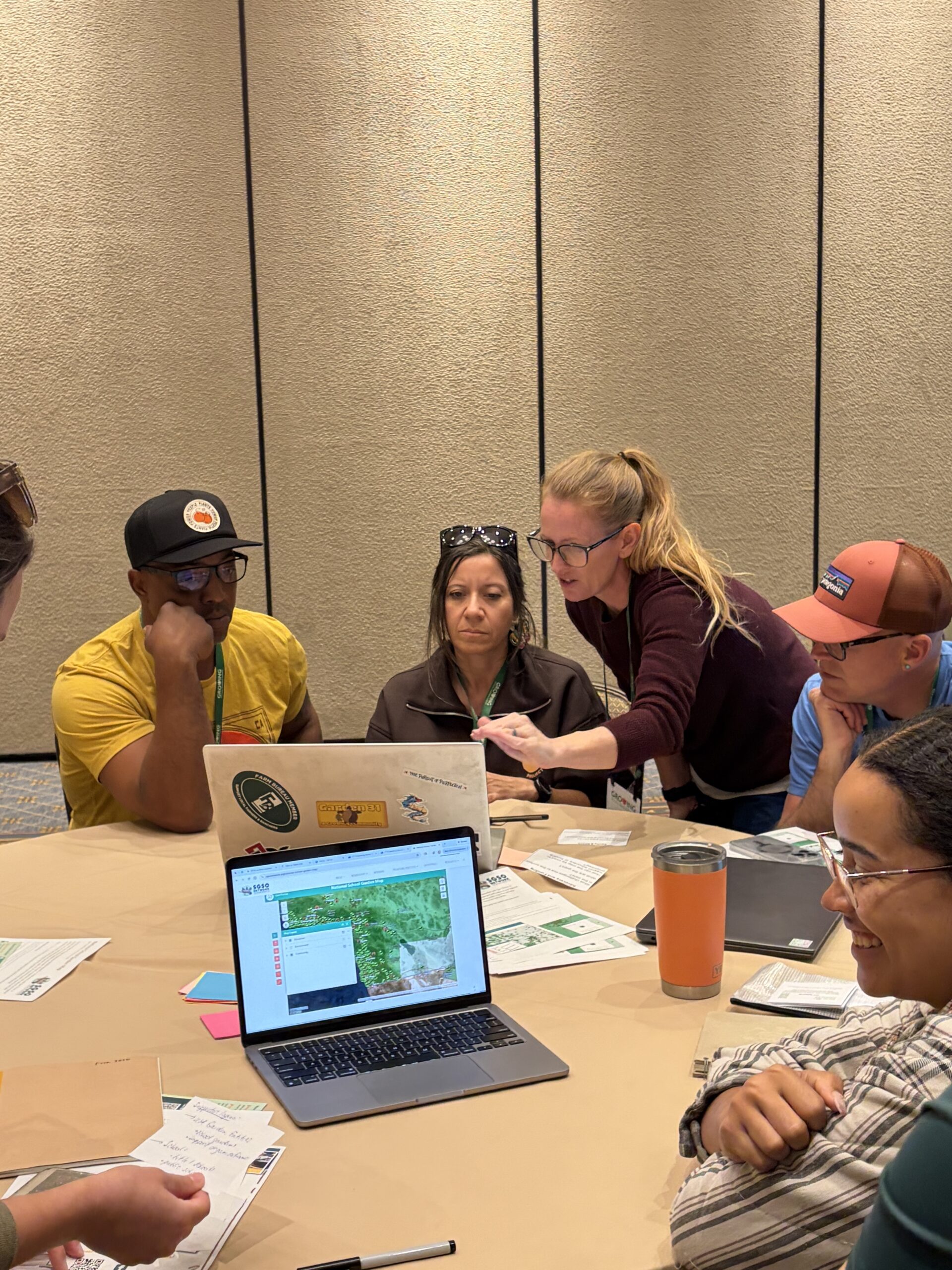
Session participants ranging from school garden educators to academics to non-profit leaders explore map layers, identified trends and brainstormed how to apply the data.
This kind of moment, where a practitioner in one part of the country suddenly sees the disparity in another, is exactly what the map is designed to produce. They quickly moved to imagining how to act. Ideas surfaced that ranged from the immediate to the systemic:
- Connect with other school garden educators and organizations in their region
- Use the map as a resource to share with unconnected schools in their area
- Strengthen grant applications with community-level data on garden access and food deserts
- Advocate with school districts to prioritize gardens at under-resourced campuses
- Build school-to-school and cross-district partnerships to spread knowledge and resources
“The field has needed something like this for a long time. This map is more than a directory; it’s a call to action. We hope funders, districts, and policymakers will use it to see where investment is missing and make bold decisions that shift resources toward the students who need them most.”
—Kristi Hibler-Luton, EcoRise and Gen:Thrive
Is Your School’s Garden on the Map? Here’s How to Get Involved
If you’re an educator, nonprofit leader, or school garden advocate, the first thing you’ll probably want to know is: is my school already on the map? Explore the map and find out. If your garden isn’t there yet or the listing needs to be updated, you can submit it through the same form.
Ongoing data collection, verification, and outreach will continue to fill gaps over time. The goal is not just a more complete dataset, it’s a living tool that grows more useful as more people use it, contribute to it, and act on what it shows.
A Movement That’s Ready to Grow
The school garden movement has always known what it was doing. Now it has the evidence to show the world, and the tools to go further, faster, and more equitably than ever before.
That next chapter starts with the community. As practitioners explore the map, submit their gardens, and surface gaps, the SGSO Network and EcoRise will develop a comprehensive report on the state of school garden access in America. The report will fuel outreach and advocacy designed to move resources toward the communities that need them most. Every partnership formed in the process, every funder who sees the data and acts on it, and every garden added to the map brings us closer to a future where every student has access to the learning that happens in living soil.
The map is live. Go explore it and if what you find sparks an idea, a partnership, or a grant proposal, that’s exactly the point.